
Operational Ontology
Dictionaries and taxonomies define what data means. The graph links those definitions to processes, controls, and applications. Rules specify when and how each definition applies.
Govern the rules. Verify the decisions.
OnToGraPh is an independent open-source framework that began as the shared ontology layer for PALO Framework and PolicyWatcher.
“Charge this expense to WBS 0017.” Finance uses that code for a posting object. The project office uses it for a work package. OnToGraPh gives an agent the context to ask “Which department?” and hold the expense until you answer.
Choose your guided case · Browse all 19 topics
How definitions, relationships and human judgment shape a governed decision.
A WBS code can mean a posting object in Finance and a work package in PMO. Give each meaning a scope, an owner and an application that uses it.
Dictionaries name concepts. Taxonomies organise them. Typed links connect concepts to fields, controls and applications. The model ties each rule to a decision scope.
An author proposes a change. Named reviewers decide whether to approve it. Observers check what applications do. A supervisor can order withdrawal and require a fresh check.
Trace a changed field to every dependent control in scope. Compare how serious an error would be, how strong the evidence is and where assessors disagree.
Start with a governance mandate in PALO or a change detected by PolicyWatcher. In both routes, connect the source to a rule someone can review and an application result someone can check.
Choose a starting point, diagnose the gap and check what happened.
Pick one shared definition or rule that changes a real decision. Identify an owner, records you can test and the system or systems that apply it. Begin with the personal example if you have one application.
Start with your current problem. Define vocabulary for a personal project, trace a rule shared across departments, ground Copilot in your company dictionary, or bring an external policy change to a human reviewer.
Choose a changed concept. If its links have no assessment, collect a source. If assessors disagree, name a reviewer. If deployment is acknowledged but behaviour is still uncertain, run a test that distinguishes the versions.
Toggle a component in the architecture puzzle. Watch which inputs, approval gates or observations become unavailable. Use those gaps to decide what to connect first.
Check whether each application acknowledged delivery, returned the expected result and stopped applying the rule after withdrawal. In the WBS case, Calc still admitted €800 after the first withdrawal attempt.
Share an example, take part in research or try a case together. Volunteer contributions are welcome.
Bring one rule change, two applications and an accountable owner for each. Agree on what must be observed during activation and withdrawal before starting.
Model a small example in the practical guide, work through disagreement in the WBS case, then reproduce the recorded checks locally.
Sign in to import a model, record dated claims and save your draft. Review and publication of a release use the registry workflow.
Describe the two systems, the data they exchange and the expected decision. Agree on who supplies test data, runs the checks and measures integration and ongoing effort.
Use email or LinkedIn for research and pilot discussions. For a reproducible technical issue, open a GitHub issue and use synthetic examples.
Explore the origins of the framework, its related projects and how to contribute.
OnToGraPh began as the shared ontology layer for PALO Framework and PolicyWatcher. Today it is an independent open-source framework. You can model your own domain, review its rules and test them in your applications.
Suggest a useful case, document a repeatable check or share feedback on the model. Include your setup, expected behaviour and a small synthetic example when possible.
The standalone registry uses a local SQLite file. Online Studio requires sign-in and saves drafts under the signed-in account. The separate research room uses a password and a session cookie.
Use, adapt and redistribute the framework code under the MIT License. The repository includes synthetic cases you can reproduce locally.
Dictionaries and taxonomies define what data means. The graph links those definitions to processes, controls, and applications. Rules specify when and how each definition applies.
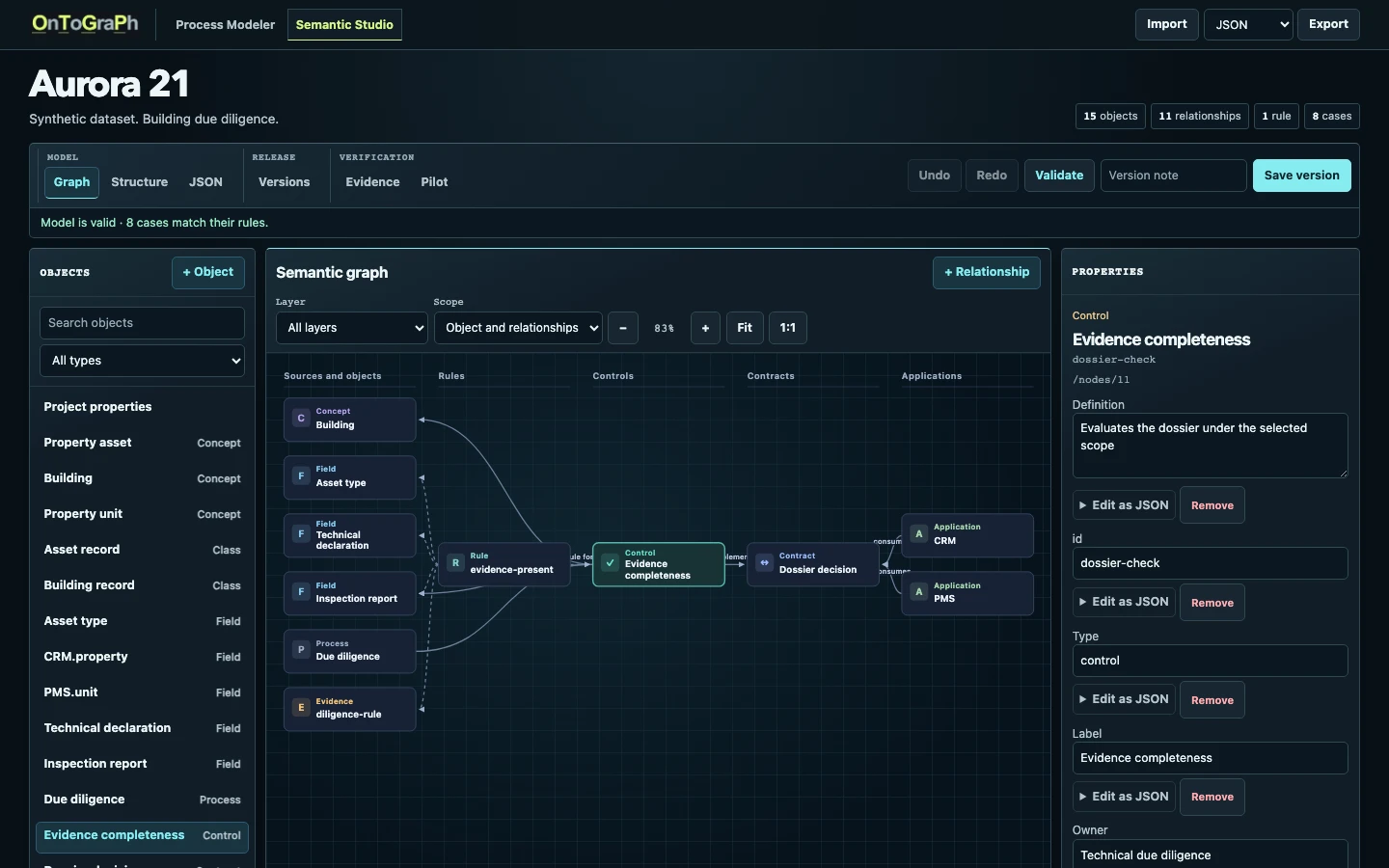
Inspect individual properties, including nested values, in the visual editor or in JSON. Follow the path from source evidence to a changed rule and see which applications depend on it.
Record the application's release receipt and an independent observation of its behavior. After a withdrawal, check whether each application has stopped applying the rule.
OnToGraPh Studio
Run OnToGraPh as a standalone Studio for dictionaries, taxonomies, ontology classes, typed relationships, fields, and versioned controls.
In the local Studio, open Evidence to compare delivery, receipts, and observations. Use Paired Pilot to assess OnToGraPh and your current stack on the same cases.
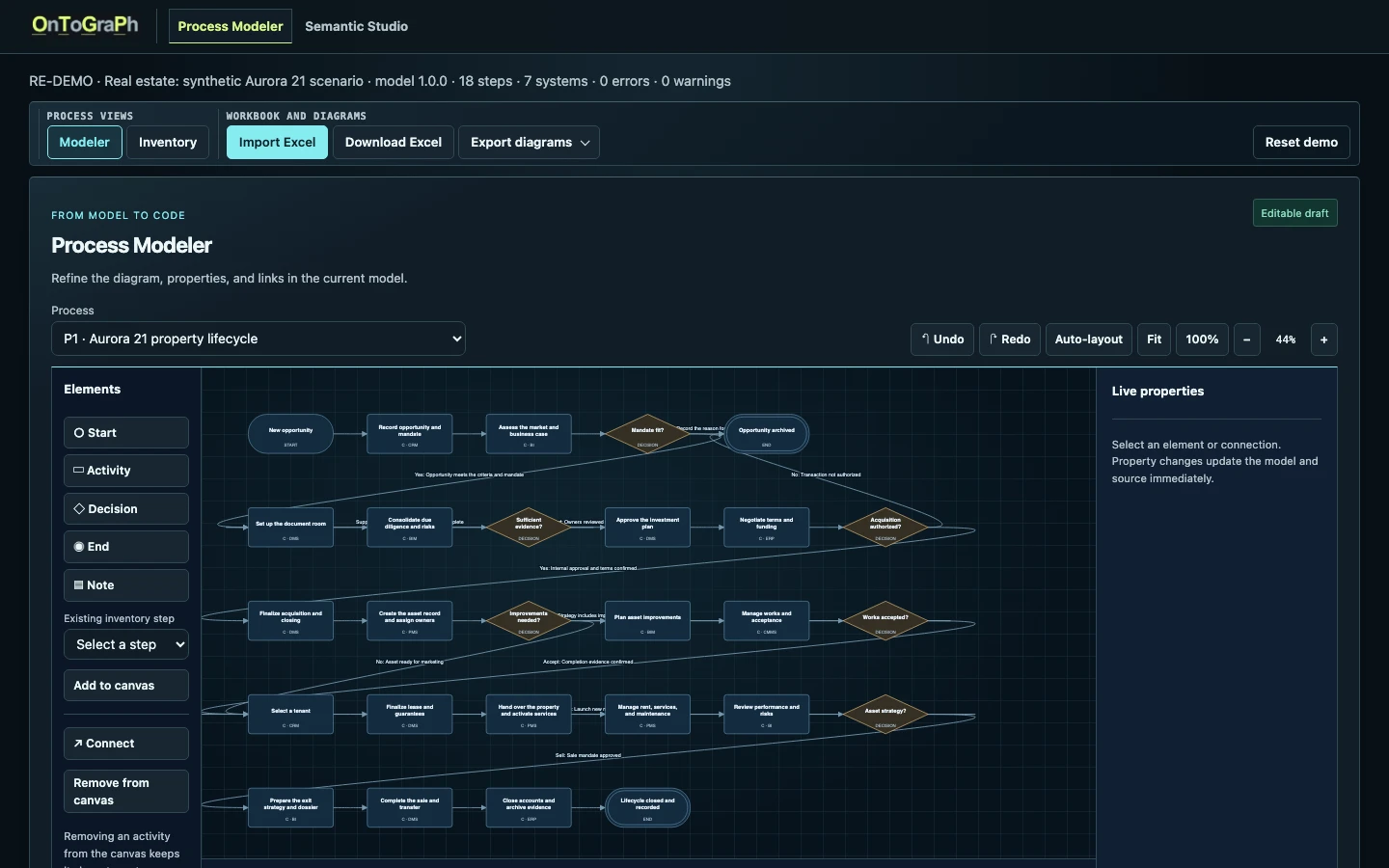
Run locally from the repository python3 -m ontograph studio
Aurora 21 · Synthetic case
A real estate dossier now requires an additional document. The CRM and property management system (PMS) both report loading the release. Given a test case without the document, the PMS still makes the decision required by the previous rule.
Use this quadrant to shortlist tools by the job you need done and the evidence you need after a change.
OnToGraPh assessment · Selected documented workflows ·
Rows show the verification scope of the documented workflows. Assess production maturity separately.
Consumer behavior after release · Focused workflow
OnToGraPhVerify downstream decisions and confirm the effect of withdrawal.
Offline reference · synthetic caseConsumer behavior after release · Dedicated semantic tooling
Combined-stack pilotKeep a dedicated semantic platform and pilot a separate layer for behavioral verification.
Model and platform checks · Dedicated semantic tooling
Scope of semantic tooling
Blue Ocean hypothesis
Start with a data governance, AI governance or operational risk team that owns a shared control across two applications with different owners. Keep the existing catalog, graph engine and delivery pipeline in place.
See the governance hubOther platforms also support weights. OnToGraPh binds a dependency’s criticality, confidence, source and assessor to a reviewed release. Teams can require completed assessments across a designated decision scope before publication. Try the month-end close example.
Run the existing process and OnToGraPh on the same rule, exception and two applications. Include an old decision behind a matching receipt and an unreachable application during withdrawal. Bind every observation to the exact application instance and activation. Any false confirmation of withdrawal fails the pilot. Measure detection time, time to verify withdrawal, evidence coverage and steward and integration hours, especially for the second adapter. Continue if the pilot surfaces a material divergence the current process misses or produces equivalent evidence at measurably lower cost.
Pilot economics and decision criteriaKeep Git/CI and your catalog if they already tie an approved release to observed decisions and verified withdrawal by application. A second governance layer adds adapter maintenance, ownership and evidence custody.
Reconsider after a paired test on real application instances. Use the same release and cases in both stacks. Require auditable evidence, then compare stale-decision detection, false withdrawal confirmations and reviewer time.
Counterargument from Inkling 2 Mini Uncensored in LM Studio, edited for clarity
The hub is one reference use of OnToGraPh’s reusable ontology layer. PALO Framework sets the governance mandate, PolicyWatcher detects source changes, and OnToGraPh is a spin-off of both that serves as the hub’s shared engine for semantic change and verification.
Top-down governance
Set the mandate, assign who can decide, define review gates, and review evidence on the case.
Bottom-up evidence
Detect a change, preserve the source and versions, and supply evidence for human review and follow-up.
Semantic change and verification
Connect a source change to the affected control, approved release, and decision observed in each application.
Open a PALO case and set its review criteria. Model the change in OnToGraPh and return release and observation records to the same case for PALO review.
Import a PolicyWatcher evidence packet into OnToGraPh for human review. Use the exported findings in the same PALO case and for follow-up in PolicyWatcher.
In the November 2026 pilot, PolicyWatcher supplied a public change through a read-only interface. OnToGraPh bound its source to a versioned rule. PALO’s local Assessment Path reopened Measure and Prove for a human reviewer. A separate calibration laboratory ran offline with its own dictionary. Explore the pilot evidence.
Read the Governance Hub guideThe public repository includes the reference engine, visual tools, and everything needed to reproduce Aurora 21 locally.

Shared ontology for AI and data governance
The first use case connected a policy change to the person responsible for reviewing it. You can use the same workflow with your own evidence, vocabulary and reviewers.
For a pilot or research collaboration, describe the decision you want to verify and the applications involved.